The Bedtime Bible Journal
How to Explain the Trinity to a Child
It usually arrives sideways. You have just finished a story about Jesus, the light is already off, and from somewhere under the blanket comes: “Wait. Is Jesus God, or is God God?”
And you stall. Not because you do not believe it, but because you suspect your own grip on this is thinner than you would like, and the last thing you want is to hand your child something you will have to walk back when they are twelve.
How to explain the Trinity to a child in three sentences
You do not need a diagram. You need three sentences you can say without hedging.
There is one God. The Father is God, the Son is God, and the Holy Spirit is God. They are not three Gods, and they are not one person taking turns wearing three hats: they are one God, three persons, always all three at once.
That is the doctrine, in language a seven year old can carry, and it is not a simplification you will have to apologize for later. Every longer version of it is a longer way of saying those same three things.
Israel’s oldest confession is the first half: “Hear, O Israel: The LORD our God, the LORD is One.” (Deuteronomy 6:4) Christians never stopped saying that sentence. We just also read the rest of the Bible.
Why the water and egg analogies backfire
Almost every parent reaches for one. Water can be ice, liquid, or steam. An egg has a shell, a white, and a yolk. A clover has three leaves. A man is a father, a son, and an employee.
They break in the same two places, and children notice.
The water version teaches that God changes forms: He is the Father for a while, then the Son for a while. That is not what the Bible shows.
The egg and clover versions teach that each person is a third of God, a piece of the whole. That is not it either. The Father is not one third of God. He is God. So is the Son. So is the Spirit.
If one of these has already been said in your house, no harm done. Just add the correction: “That helps a little, but it is not quite right, because God is not made of parts and He does not change costumes.”
Then give them a scene instead of a comparison. A scene cannot break the way an analogy breaks.
Use the baptism, not a diagram
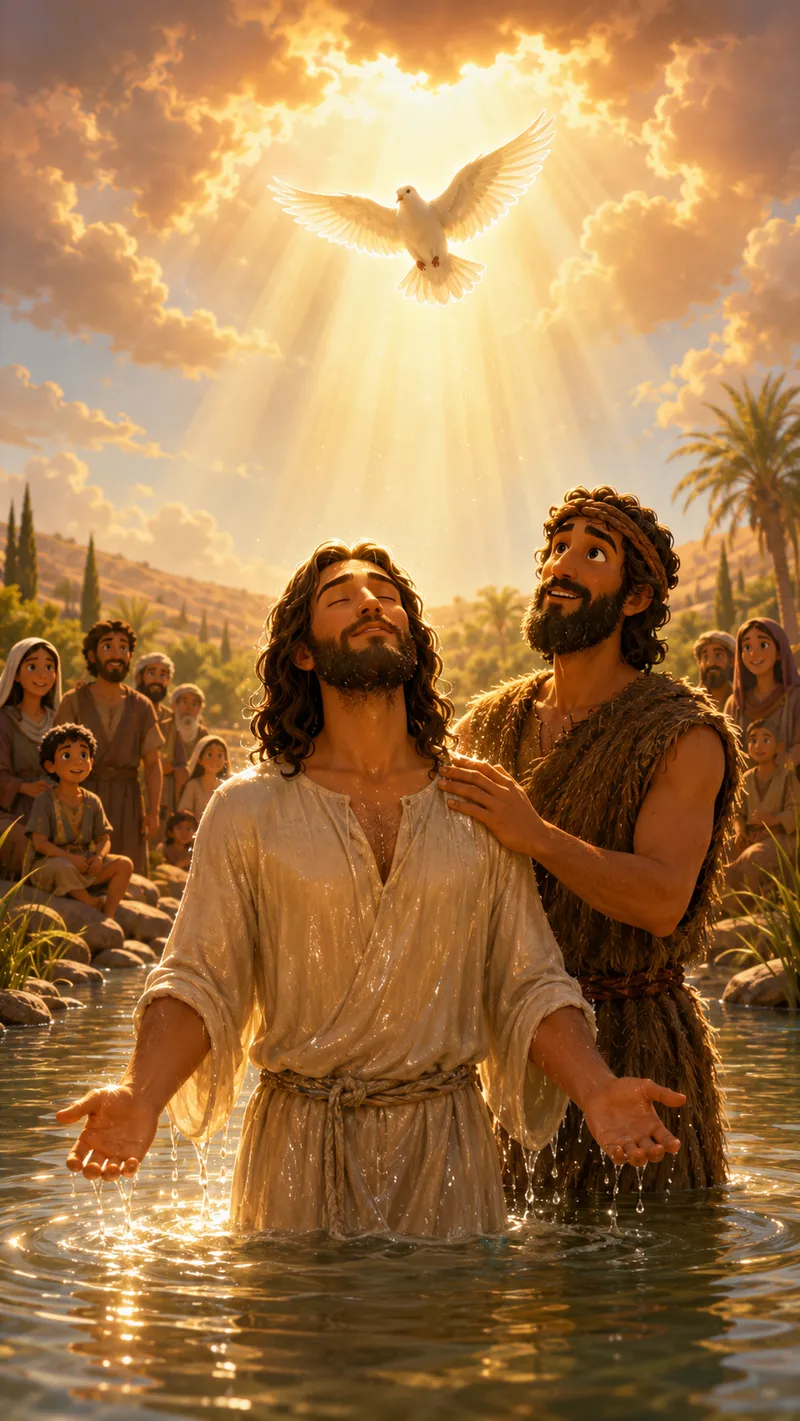
This is the passage to keep in your pocket. Jesus comes up out of the Jordan River, and here is what happens:
“As soon as Jesus was baptized, He went up out of the water. Suddenly the heavens were opened, and He saw the Spirit of God descending like a dove and resting on Him. And a voice from heaven said, ‘This is My beloved Son, in whom I am well pleased!’” (Matthew 3:16-17)
Count what is in the frame. The Son is standing in the water. The Spirit is coming down like a dove. The Father is speaking from heaven, and what He says is that He loves His Son.
Three, at once, in one river, on one afternoon. No costume changes, no thirds.
Your child does not have to reason their way from that scene to the doctrine. They just have to see it. The three sentences above then work as a caption for a picture they already have.
Jesus’ own last instruction has the same shape, three names held together as one: “baptizing them in the name of the Father and of the Son and of the Holy Spirit.” (Matthew 28:19) One name. Three persons.
What this sounds like at each age
Two and three year olds do not need the word Trinity. “God is the Father, and Jesus, and the Holy Spirit, and they love each other” is plenty.
Four to six can hold the river scene and count the three.
Seven and eight can take the three sentences straight, and this is usually the age the question shows up.
Eight and up will find the hole and press on it, which is a good sign. That is when you say the honest thing: nobody fully understands how God is one and three, including people who have studied it their whole lives. We know it is true because it is what God shows us about Himself, not because we can picture it.
Saying that is not a failure. A God your child could fully diagram by nine would be a very small one.
Tonight
If the question has already come up, go back to it once, on purpose, when nobody is upset or overtired. Read Matthew 3:16-17 out loud, then ask your child how many of them were there. Let them find all three themselves.
Bedtime Bible Stories tells A Man Called John the Baptist four separate times, once for each age band from two to twelve, with three discussion questions attached so the next question has somewhere to go.