The Bedtime Bible Journal
How to Stop Bedtime Stalling Without a Battle
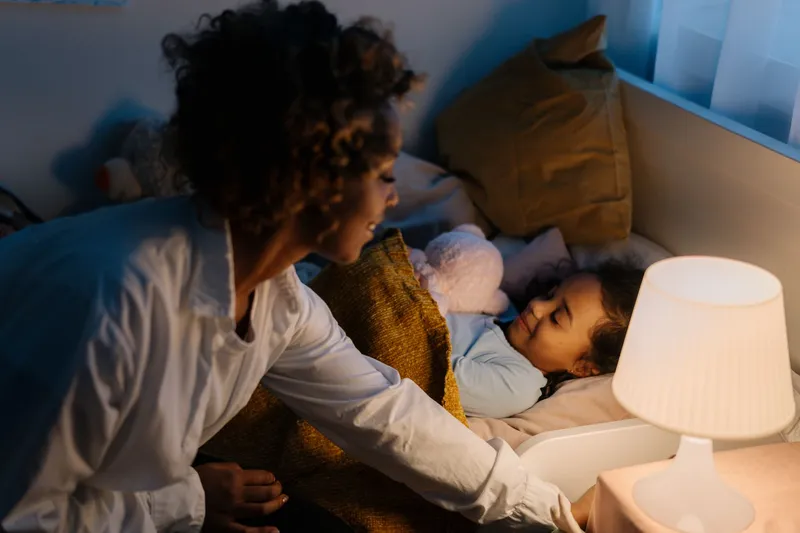
You said goodnight at 8:15. It is now 8:47. There has been a glass of water, a bathroom trip that produced nothing, a lost stuffed animal that was under the pillow, and a sudden urgent question about whether dogs go to heaven.
You are not annoyed at the question. You are annoyed that it arrived now, and that you can feel the next four arriving behind it.
How to stop bedtime stalling: give the routine an ending
Most stalling is not defiance. It is a child noticing that the day is over and that the next part happens alone, in the dark. The requests are a way of keeping you in the room. That is worth knowing, because it changes what actually works. You are not looking for a way to win. You are looking for a way to end the evening that your child can see coming.
A routine with no named last step can always be extended. So name the last step, out loud, every night, in the same order. Story, prayer, blessing, lights out. Four things. Your child learns the shape of it within a week and stops testing where the edge is, because the edge is obvious.
Keep it short. University Hospitals advises that if your routine runs an hour or more, shorten it, “perhaps by doing some of the activities in the routine earlier in the evening or day.” A long routine is not more soothing. It just gives stalling more places to live.
Front-load the requests
The single most useful change is moving the requests to before the bedroom. Get the water, do the bathroom, find the animal, all of it, and say plainly that this is the last drink of the day. University Hospitals recommends exactly this: address all these wants before moving to the bedroom, and label them as the last of the day.
Then, once the bedroom part starts, the rule is that you do not negotiate. Not sternly. Just steadily. “We already did water. It is story time now.” Nationwide Children’s Hospital puts the same principle plainly: stick to firm bedtime limits, and remind a child who calls out one time that it is bedtime, keeping any check-in brief and boring rather than soothing.
Both of those hold up in practice for one reason. A child who gets a different answer on the fifth ask has learned that the answer depends on how tired you are.
Answer the bid, not the request
The dogs-in-heaven question is real. It is also not answerable at 8:47 by a person who has been awake since six.
You can honor it without reopening the day: “That is a real question, and I want to think about it. Put it on the list for breakfast.” The catch is that you then have to do breakfast. Do it once and your child learns that a question saved is not a question lost, which takes most of the urgency out of the 8:47 version.
If your child gets out of bed, Nationwide Children’s advice is to firmly and calmly return him to bed. Calmly is doing most of the work in that sentence. The walk back is not a conversation.
The last line
Here is where a family bedtime has something a sleep schedule does not. You can end on words that hand the night to someone other than you.
“I will lie down and sleep in peace, for You alone, O LORD, make me dwell in safety.” (Psalm 4:8)
Say it as the blessing, the same words every night, after the prayer. It is short enough for a four year old to say along with you by the end of the month. And notice what it does: the safety in that verse does not come from you being nearby or from the hall light. That is a load off a child who has worked out that you also go to sleep.
For a two or three year old, use the second half only. At four to six, the whole verse works. At seven or eight, they will start saying it with you. At eight and up, some kids want to swap in their own line, and that is a good sign, not a lost tradition.
Expect a hard few nights
Nationwide Children’s is honest about the timeline: the first few nights are likely to be very challenging, with major improvements over the first few weeks. Knowing that in advance is the difference between holding the line and concluding on night two that it does not work.
Tonight
Pick your last line and say it. That is the whole assignment. Not the full four-step routine, not the front-loading system, just the same closing words tonight and again tomorrow, so there is something at the end of the evening that signals the end of the evening.
If it helps to have the story slot already handled, Bedtime Bible Stories has 82 stories written four separate times, once for each age band, so the story step stays about the same length whether you are reading to a three year old or a ten year old.