The Bedtime Bible Journal
Why Can't I See God? A Parent's Plain Answer
The question almost always arrives about ninety seconds after you have said the reassuring thing. You tell your child God is right here with them, the light goes off, and a voice comes out of the dark: “Then why can’t I see him?”
It is not a challenge. It is your child doing honest arithmetic with the information you just gave them, and coming up one short.
Start by agreeing with them
The instinct is to reach for “you just have to have faith.” Try not to. A child hears that as a polite way of saying stop asking, and the question does not go away, it just stops being asked out loud.
The better opening is to tell them they have noticed something true, and that the Bible says it first. “No one has ever seen God, but the one and only Son, who is Himself God and is at the Father’s side, has made Him known.” (John 1:18)
That is a strange and freeing verse to read to a seven year old. Nobody has seen God. Not you, not their Sunday school teacher, not the people in the stories. Your child is not failing at something everyone else manages.
How to explain why we can’t see God to a child
Here is the part that actually answers the question. God is not invisible the way a hidden thing is invisible. He is not behind something, and he is not too far away. He was never the kind of thing eyes are built to see.
“God is Spirit, and His worshipers must worship Him in spirit and in truth.” (John 4:24)
The analogy that lands, and the one the writer at Prepared to Answer uses with his own kids, works like this: you can see my body, and I am in here, but the part that makes me actually me is not something you can look at. Your child accepts this immediately, because they already believe it about themselves.
You can extend it one step. Your child has never seen your love for them either. They have seen what it does: the packed lunches, the sitting on the edge of the bed long after you wanted to be downstairs. They have never once doubted it exists.
One limit worth keeping. Do not let the analogy slide into “God is a nice feeling inside you.” God is a person who thinks and decides and speaks. Feelings do not part seas. If your child is old enough to catch the difference, say so.
Then point at Jesus, because that is the actual Christian answer
Christianity does not stop at “God is invisible.” It makes a much stranger claim, which is that God handled this problem himself.
“The Son is the image of the invisible God, the firstborn over all creation.” (Colossians 1:15)
Go back to John 1:18 and read the second half again: the Son “has made Him known.” So when your child asks what God is like, the answer is not a shrug about mystery. It is a face. What God is like is what Jesus is like. Patient with the slow ones, unbothered by important people, willing to stop a whole crowd for one sick woman.
This is why the stories matter, and it is worth saying to your child in one sentence: we cannot see God, so he came where we could see him, and people wrote down what he did.
What lands at each age
At two to three, keep it to one line: we can’t see God, and he can still see us. That is the entire conversation, and it is enough.
At four to six, the body-and-spirit picture works. You can’t see the real me either, and I’m right here.
At seven or eight, this is often when the question gets sharp, because they have started noticing that they cannot see anything they are told to believe in. Give them John 1:18 straight. The honesty of it does more good than a smoothed-over answer.
At eight and up, they can hold the whole thought: God is Spirit, so seeing was never the point, and Jesus is God making himself visible on purpose. Kids this age often ask the follow-up, which is whether we will see God later. You can tell them the Bible says yes, one day, and that you are looking forward to it too.
What not to say
Two things to avoid. Do not say “if you believe hard enough you’ll feel him,” which turns your child’s ordinary night into a test they can fail. And do not answer with certainty you do not have. “I don’t know” followed by “let’s find out” costs you nothing and buys you the next ten years of questions.
Tonight
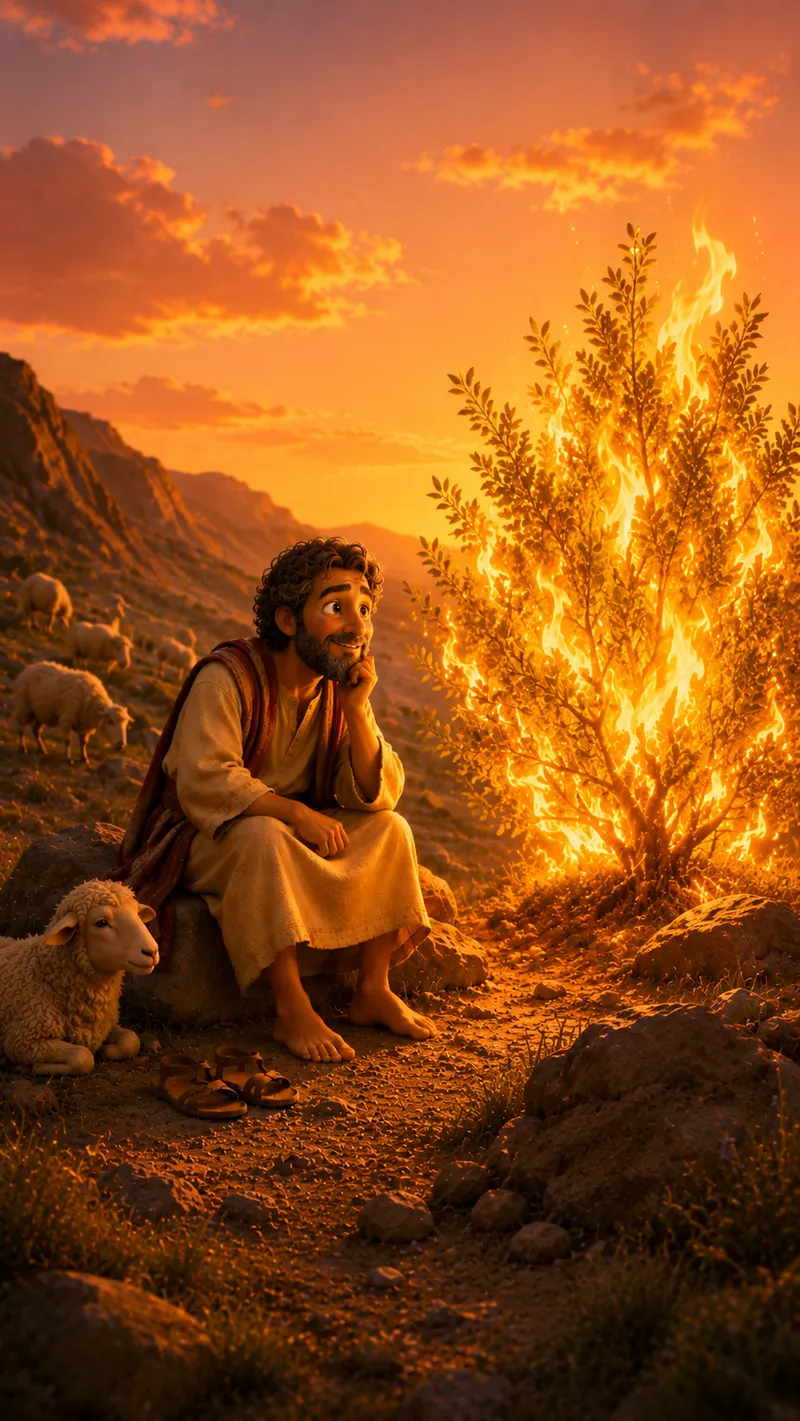
Tell them the burning bush. Moses does not see God. He sees a bush that will not burn up, he hears a voice, and he takes his shoes off. It is the clearest picture in the Bible of God being unmistakably present and not remotely visible, and it gives your child something to hold that is not an argument.
The burning bush is one of the 82 stories in Bedtime Bible Stories, written four separate times so the version a four year old hears is not the version an eleven year old hears, each with three discussion questions for the nights the questions keep coming.